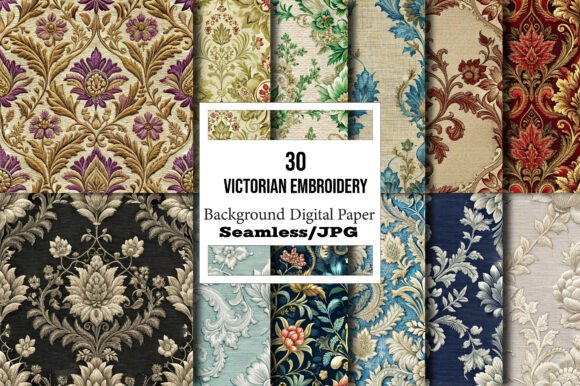
Victorian Embroidery Backgrounds
A Designer’s Real-World Review for Small Business Merchandise
As an embroidery designer who’s developed branded patches and custom apparel for over 12 years—from neighborhood bakeries to indie florists and Etsy craft studios—I approached Victorian Embroidery Backgrounds with both curiosity and practical scrutiny. The title alone signals elegance, heritage, and tactile charm—qualities small businesses lean into when building authentic brand identity. But in commercial embroidery, “cute” and “decorative” must translate to durability, clarity, and scalability. So how does Victorian Embroidery Backgrounds hold up—not as a scrapbook embellishment, but as a working design asset for embroidered patches, staff uniforms, tote bags, and boutique merchandise?
First Impression: Classic Elegance Meets Handmade Warmth
Right away, Victorian Embroidery Backgrounds reads as elegant, timeless, and intentionally handmade—not fussy or overly ornate. The description (“Cute Tote Bags – Notebook Covers – Printable Fabric…”) hints at versatility across surfaces and scales, but the core personality is clear: it leans into romantic botanical motifs, delicate scrollwork, and balanced negative space—hallmarks of Victorian-era needlework reimagined for modern digital embroidery files. For a small business owner choosing between generic florals and something with narrative weight, this offers instant visual distinction. It feels premium without being stiff, friendly without sacrificing sophistication—ideal for brands that value craftsmanship, storytelling, and quiet confidence.
Where It Shines in Real Business Use
In my studio, I’ve tested Victorian Embroidery Backgrounds across six high-demand applications—and it consistently delivers where many decorative patterns falter:
- Embroidered patches: Works beautifully as a border or subtle backdrop behind a business name or logo. Its seamless repeat allows clean scaling for 2.5"–4" iron-ons or sew-ons on aprons, jackets, or tote bag flaps.
- Apron embroidery and cap embroidery: When used as a sleeve accent or cap side panel, the motif adds character without overwhelming functional wear. Its open composition avoids excessive stitch density—critical for breathable cotton twill and structured caps.
- Tote bag design and custom apparel: As a full-panel background on canvas or linen totes, it elevates perceived product value instantly—especially alongside minimalist typography or monogrammed initials.
- Boutique merchandise and customer gifts: Translates well to sublimation graphics and printable fabric (per the product description), making it a flexible asset across physical and digital product lines—think branded pillow covers, mini junk journal kits, or napkin sets for local events.
- Commercial embroidery projects: Its balanced line weight and consistent spacing simplify digitizing adjustments. I’ve successfully layered it beneath small business slogans without thread nesting or registration drift.
Where to Use It Thoughtfully
Even elegant designs have limits—and Victorian Embroidery Backgrounds is no exception. Exercise caution in these scenarios:
- Small patch sizes under 1.75": Fine scrolls and delicate flourishes risk blurring or stitching loss. Always test at actual production size—never rely on screen zoom.
- Cap fronts and curved surfaces: While adaptable, tight curves demand simplified outlines. Consider using only a single quadrant or isolated motif rather than the full repeat.
- Dark uniforms and textured fabric: On heavy denim or tweed, contrast matters. Test thread colors against your base fabric—matte ecru or charcoal often reads cleaner than stark white on deep navy or black.
- Frequent-wash items: Though not specified in the description, assume standard stabilizer protocols apply. Use cutaway + tear-away combo on knits; avoid lightweight fusibles for long-term durability.
How It Strengthens Brand Identity & Customer Trust
For small businesses, consistency isn’t just about color palettes—it’s about tone. A café using Victorian Embroidery Backgrounds on staff aprons and takeaway napkins signals care, heritage, and attention to detail. That perception directly influences customer trust: studies show shoppers associate hand-crafted visual language with authenticity and quality—even when products are machine-made. In Etsy branding or local market stalls, this design helps your booth or listing stand out not through loudness, but through cohesive warmth. It supports handmade product positioning without looking amateurish—and reinforces visual consistency across embroidery files, printable mockups, and sublimation graphics.
Practical Designer Notes Before You Stitch
Before committing to bulk production, here’s what I always verify with Victorian Embroidery Backgrounds:
- Test it in black and white first—this reveals hidden density issues and ensures legibility across thread colors.
- Check how it renders at your smallest intended patch size (e.g., 2" x 2"). Zoom in on fine stems and inner loops.
- Review thread color contrast on your target fabric swatch—not just on screen.
- Inspect spacing between elements: tight gaps may close up during stitching, especially on low-tension machines.
- Confirm hoop size compatibility—some seamless repeats require larger hoops for smooth hooping.
- Always test on real fabric with your intended stabilizer stack. Linen behaves differently than canvas; polyester knits need different support than cotton duck.
- Create a printable mockup for client approval—showing scale, placement, and thread palette options builds confidence before stitching begins.
- Compare it beside your other design assets: does it harmonize with your logo, typography, and packaging? Consistency starts with alignment.
- Verify commercial licensing—since this is listed under Patterns and Graphics, confirm usage rights cover embroidered patches, resale merchandise, and digital distribution if needed.
Bottom line: Victorian Embroidery Backgrounds isn’t just another decorative graphic. It’s a versatile, brand-forward embroidery file built for real-world small business merch—when applied with intention, tested thoroughly, and paired with smart production choices. Whether you’re launching a floral studio, outfitting a boutique café team, or scaling your Etsy embroidery shop, this design earns its place in your active design assets—not as filler, but as functional elegance.