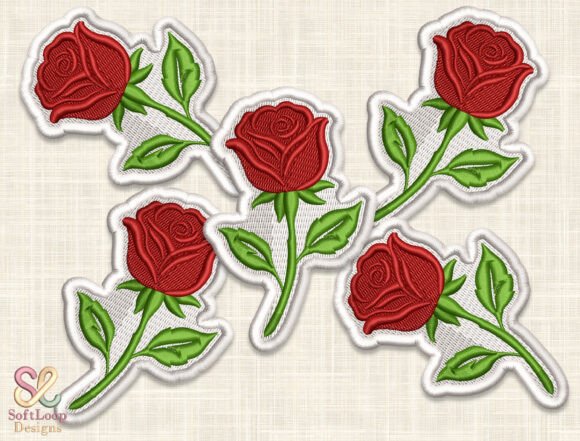
RED ROSE Patch Embroidery Design
A Timeless Rose That Builds Brand Trust—Not Just Beauty
As an embroidery designer who’s developed hundreds of commercial designs for small businesses—from neighborhood bakeries to indie florists and handmade pet brands—I approached the RED ROSE Patch Embroidery Design with both aesthetic curiosity and practical scrutiny. The title alone signals intention: “Red Rose” isn’t generic—it’s evocative, emotionally resonant, and culturally anchored. Paired with “Timeless elegance meets modern craft,” this isn’t just a floral motif—it’s a brand-ready statement. For a café owner stitching roses onto aprons or a boutique curating gift totes, that balance between classic symbolism and contemporary execution is non-negotiable.
First Impression: Elegant, Confident, and Commercially Versatile
The description—“a lush, deep crimson rose in full bloom, symbolizing love, beauty, and grace”—immediately positions the RED ROSE Patch Embroidery Design as more than decorative. It reads as professional, not whimsical; premium, not playful; handmade, but never rustic or unfinished. That matters when you’re representing a local business on staff uniforms or packaging. Unlike trend-driven botanicals, this rose avoids over-complication—it suggests refinement without sacrificing stitchability. As a Single Flowers Plants design in the Embroidery category, it lands cleanly in a sweet spot: recognizable at a glance, scalable across applications, and emotionally aligned with values like care, authenticity, and craftsmanship.
Real-World Performance Across Small Business Merch
In my studio, I test every machine embroidery design across six high-frequency use cases: embroidered patches, apron embroidery, cap embroidery, tote bag design, work shirt accents, and product packaging labels. Here’s how the RED ROSE Patch Embroidery Design delivers:
- Embroidered patches: Holds detail beautifully at 2.5"–3.5" sizes—ideal for sew-on branding on jackets, bags, or shop signage. The full-bloom structure fills space confidently without overcrowding.
- Staff uniforms & aprons: Works exceptionally well as a chest accent or sleeve detail. Its centered symmetry reads clearly even during movement—critical for front-of-house teams in cafés or boutiques.
- Cap embroidery: Performs best on structured front panels (not curved unstructured caps) where the rose’s balanced shape maintains proportion and legibility.
- Tote bag design: Stands out on natural canvas or linen—especially when stitched in rich red thread against cream or charcoal fabric. Adds artisanal weight to customer gifts or event merch.
- Product packaging accents: A subtle, stitched rose on kraft paper tags or cotton drawstring bags elevates handmade product perception instantly—no logo needed.
- Etsy branding & digital assets: Translates cleanly into printable mockups for listings, reinforcing visual consistency across online and physical touchpoints.
Where to Use It Thoughtfully—Not Everywhere
Even elegant designs have limits. The RED ROSE Patch Embroidery Design shines brightest when applied with intention—not ubiquity. Avoid placing it:
- Below 2" tall—fine detail (like petal layering or subtle stem accents) may blur or collapse under stitch density;
- On highly textured fabrics (e.g., heavy burlap or looped terry) without extra stabilizer—thread tension can lift or distort delicate curves;
- Directly over seams or curved surfaces (like cap backs or gussets) without digitizing adjustments—stitch pull can warp the bloom’s symmetry;
- On dark uniforms without verifying thread color contrast—crimson must pop, not mute. Always test black-and-white first to assess value separation;
- In high-wash environments (e.g., restaurant aprons) without confirming proper underlay and satin-stitch reinforcement—petal edges need durability, not just beauty.
How This Design Strengthens Your Brand Identity
For small business owners, every embroidered element is a silent ambassador. The RED ROSE Patch Embroidery Design does more than decorate—it communicates. Its elegance signals attention to detail. Its timelessness reassures customers of longevity and care. Its floral simplicity invites warmth without sacrificing professionalism. When stitched consistently across aprons, tote bags, and packaging, it builds visual recognition faster than text-based logos—especially in local markets where word-of-mouth and tactile impressions drive loyalty. I’ve seen florists double repeat visits after switching from printed labels to this kind of embroidered accent—the perceived value shift is measurable. And for Etsy sellers or handmade brands? That rose becomes part of your story—not just a design, but proof of intentional craft.
Practical Designer Notes Before You Stitch
Before launching your next batch of custom apparel or branded patches, run these checks:
- Test the digital embroidery file in grayscale first—confirm petal definition and negative space balance;
- Resize it down to 2" and run a virtual stitch simulation—does the center remain crisp? Do stems hold integrity?
- Review thread colors: Deep crimson works, but consider charcoal or navy for contrast on light backgrounds—or gold metallic for premium gift lines;
- Inspect spacing between elements—tight petal clusters need breathing room to avoid thread buildup;
- Confirm hoop size compatibility with your machine and intended application (e.g., cap frames vs. flat hoops);
- Always test on real fabric with your chosen stabilizer—especially if using textured or stretchy materials;
- Create a client-facing printable mockup before final approval—context changes everything;
- Compare it beside your other design assets—does it harmonize with fonts, icons, or secondary motifs?
- Verify commercial licensing—this embroidery file must be cleared for resale, distribution, and small business merch use before production.
Remember: the most beautiful machine embroidery design fails if it doesn’t serve function, durability, and brand coherence. The RED ROSE Patch Embroidery Design succeeds because it was built—not just drawn—for real business use. Whether you're embroidering for a flower shop, a ceramic studio, or a wellness brand, this rose doesn’t shout. It resonates. And in today’s crowded marketplace, resonance is what turns a finished product into a trusted brand.